


Glorious vs Razer Gaming Mouse: Is There Actually a Difference?
Guides & Resources
Jul 09 2026
Glorious and Razer gaming mice differ mainly in weight, price, and where the engineering budget goes. At the wired budget tier, the $39.99 Model O Eternal weighs 55g against the $29.99 DeathAdder Essential's 96g. At the wireless flagship tier, the $159.99 Model O3 Wireless swaps batteries without disconnecting, while the $169.99 DeathAdder V4 Pro is lighter at 56g but recharges over a single cable. Neither brand wins across the board - they're built around different priorities.
Glorious vs Razer Gaming Mouse: The Headline Comparison
Razer basically invented the modern gaming mouse category with the original DeathAdder back in 2006. Glorious showed up years later and built its name on ultralight shapes and a lower price of entry. Both are still true today, just not in the way the marketing on either side would have you believe. Here's what the spec sheets and official pricing pages actually say, compared line for line at two price tiers.
Budget tier - wired
| Spec | Glorious Model O Eternal | Razer DeathAdder Essential |
|---|---|---|
| Price | $39.99 | $29.99 |
| Weight | 55g | 96g |
| Sensor | PixArt 3311 Optical | Razer optical, 6,400 DPI |
| Max DPI | 12,000 | 6,400 |
| Polling rate | 1,000 Hz | Not published |
| Switches | 80M-click rated | Razer Mechanical Switches, 10M-click rated |
| Buttons | 6 | 5 |
| RGB lighting | Dual-zone | None |
| Warranty | 2 years | 2 years |
Premium tier - wireless
| Spec | Glorious Model O3 Wireless | Razer DeathAdder V4 Pro |
|---|---|---|
| Price | $159.99 | $169.99 |
| Weight | 66g with battery / 59g without | 56g |
| Sensor | BAMF 3.0, 30,000 DPI | Focus-class, 45,000 DPI |
| Max speed / acceleration | 750 IPS / 50G | 900 IPS / 85G |
| Polling rate (wireless) | Up to 8,000 Hz, native | Up to 8,000 Hz, native |
| Switches | 130M-click optical | 100M-click optical, Gen-4 |
| Battery life | Up to 71 hrs (2.4GHz) / 130 hrs (Bluetooth) per pack, 2 packs included | Up to 150 hrs, single internal battery |
| Battery swap | InfinitePlay hot-swap, no disconnect | None - recharge via USB-C cable |
| Buttons | 6 | 5 + DPI button |
Look at the raw numbers and the story is trades, not blowouts. Razer's sensor specs edge higher on paper, and its V4 Pro is genuinely lighter. Glorious answers back with a lower price at both tiers, a hot-swappable battery, and switches rated for more clicks before they start feeling mushy. Whether that trade is worth it depends on what you're optimizing for, which is what the rest of this piece breaks down. For the wider field beyond just these two brands, the best gaming mouse guide rounds up the category.
Weight: What the Scale Actually Says
Weight gets thrown around as a marketing bullet point more than almost any other mouse spec, so it's worth grounding in actual grams.
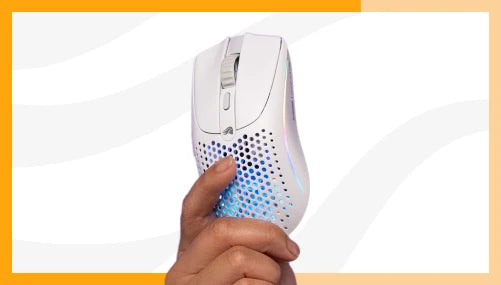
At the budget tier, the gap is not close. The Model O Eternal weighs 55g, while the DeathAdder Essential weighs 96g - a 41g difference, or roughly 75% heavier on the Razer side. PC Gamer's Reece Bithrey called the Model O Eternal "one of the lightest mice I've used in recent times," noting it comes in 30g lighter than the Logitech G203, a common budget comparison point.
At the premium tier, the story flips. The DeathAdder V4 Pro weighs 56g, more than 10% lighter than its own predecessor according to Razer. The Model O3 Wireless weighs 59g without its battery pack installed, or 66g with one in - meaning the two mice are close to parity unloaded, but Glorious's swappable-battery design adds weight back once you're actually powered up. PC Gamer's Jacob Fox weighed his Model O3 Wireless review unit at 67g on his own scale and called it "plenty light and definitely within the 'lightweight gaming mouse' bracket," while noting it's "not the lightest on the market these days."
So: if raw grams at the wired budget tier is the deciding factor, Glorious wins clearly. If raw grams at the wireless flagship tier is the deciding factor, Razer's dedicated ultralight engineering wins by about 10g.
Price-to-Feature Ratio: What $10-$30 Actually Buys
Price differences at both tiers are small in absolute dollars, which makes it worth asking what each side of the gap actually pays for.
At the budget tier, the DeathAdder Essential undercuts the Model O Eternal by $10 ($29.99 vs $39.99). For that $10, the DeathAdder Essential gives you a simpler mouse: half the max DPI (6,400 vs 12,000), no RGB lighting, and switches rated for 10 million clicks against the Model O Eternal's 80 million. Reece Bithrey's PC Gamer review put it plainly: the Model O Eternal "gets everything right for its price tag," calling it "the bargain of the century" relative to its nearest budget comparison.
At the premium tier, the direction reverses slightly - Glorious is the cheaper option by $10 ($159.99 vs $169.99), and you get a second battery pack plus a charging hub in the box. Razer's $169.99 gets you a single mouse, a single internal battery, and a lighter shell with a higher-spec sensor on paper. Neither price is unreasonable for what's included; the question is whether you'd rather pay less and get a spare battery and a hot-swap system, or more for a lighter shell and a higher polling ceiling on the sensor spec sheet.
Price parity this close means the deciding factor usually isn't the sticker price - it's which features you'd actually use. A player who never touches DPI above 3,200 gets little practical value from the DeathAdder V4 Pro's 45,000 DPI ceiling over the Model O3 Wireless's 30,000. Buy the feature you'll use, not the number that's bigger on a spec sheet. For a deeper look at what "budget" actually gets you across more of the category, the best budget gaming mouse guide covers more ground than this single match-up.
Build Quality and Durability
Click lifespan and warranty terms are the two most concrete build-quality numbers either brand publishes, so they're the fairest place to compare.
Glorious rates the Model O Eternal's switches at 80 million clicks and the Model O3 Wireless's at 130 million, both backed by a 2-year warranty. Razer rates the DeathAdder Essential's mechanical switches at 10 million clicks and the DeathAdder V4 Pro's newly redesigned Gen-4 optical switches at "over 100 million" - a substantial jump from the Essential tier, and closer to parity with Glorious at the premium tier. Razer also offers a 2 year warranty on their mice.
Reece Bithrey's hands-on impression of the Model O Eternal's build noted the frame "feels comfortable in hand" with "useful texturing." Jacob Fox's Model O3 Wireless review echoed that everything "feels well made, from the matte shell to the sturdy scroll wheel...."
At the switch-lifespan level, Glorious's numbers are higher at both tiers. At the finish-and-feel level, both brands get genuine praise across both product lines.
Wireless Reliability: Hot-Swap vs Single Battery
This is the one feature category where the two products in this comparison are architecturally different, not just numerically different.
The Model O3 Wireless ships with two swappable 200mAh battery packs and a charging hub. A small internal battery, which Glorious calls the Guardian Battery, keeps the mouse powered for the few seconds it takes to pull one external pack and slide in the other, so the connection never drops mid-swap. Jacob Fox tested this directly: "your mouse doesn't disconnect while swapping out your batteries, which means you're less likely to run into any strange issues," calling the whole system "a genuine quality-of-life improvement."
The DeathAdder V4 Pro takes the opposite approach: one sealed internal battery rated for up to 150 hours, charged over USB-C when it runs down. That's a genuinely long runtime per charge, and for players who charge overnight on a routine, it's a non-issue. It does mean that if the battery dies mid-session with no cable nearby, you're done until you find one - there's no spare pack to swap in.
Neither approach is objectively correct. A single 150-hour battery is simpler and needs less to carry around. Two swappable packs mean more gear in your bag but zero mid-session downtime if you're at a LAN, a tournament, or just forgot to charge overnight. If you've ever had a mouse die three rounds into a match, the hot-swap system solves a problem you've actually had.
Answering the Objections
"Razer has the brand name - is Glorious actually trusted?" Glorious doesn't have Razer's 2006 head start or its console and laptop ecosystem, but its mice show up in the same review cycles from the same outlets. PC Gamer has reviewed both the Model O Eternal and Model O3 Wireless with named bylines, star ratings, and specific pros and cons - the same treatment given to Razer's lineup. Brand recognition and independent review coverage are different things, and the coverage exists.
"Aren't budget mice just worse-built premium mice?" Not automatically, and not measurably here. The Model O Eternal is Glorious's budget wired option, and its switches are rated for 80 million clicks - eight times the DeathAdder Essential's 10 million, despite costing $10 more. A lower price tier doesn't mean the same brand builds it worse; it usually means fewer extras (no RGB on the Essential, a lower DPI ceiling) rather than a lower-quality core.
"Why does weight matter so much in the marketing?" Because it's one of the few mouse specs that's directly felt, every match, without needing a benchmark to notice it. A 41g difference at the wired tier is roughly the weight of a few coins taped to the bottom of your mouse for every match you play. That's also exactly why it's worth checking the actual number for the tier you're buying in, rather than assuming "ultralight" branding on the box settles it - as the numbers above show, Glorious leads on weight at one tier and trails at the other.
One shape note worth flagging: the DeathAdder lines are right-handed ergonomic designs, built around a palm or claw grip that fits into your hand's natural curve. The Model O lines are symmetrical and ambidextrous, workable for a wider range of grip styles including fingertip. If shape and grip compatibility matter more to you than any spec in the tables above, the ergonomic vs. ambidextrous mouse guide covers that decision in more depth than a brand-versus-brand piece can.
Which One Should You Buy?
Pick the Model O Eternal if: you want the lightest wired mouse in this comparison, you want RGB lighting at the budget tier, or you'd rather pay $10 more for switches rated at 8x the click lifespan.
Pick the DeathAdder Essential if: $29.99 is a hard ceiling, you prefer a right-handed ergonomic shape over a symmetrical one, or RGB and higher DPI aren't priorities.
Pick the Model O3 Wireless if: you want a lower price than the V4 Pro, you want a hot-swappable battery for zero-downtime sessions, or you want more clicks of rated switch life before things start feeling loose.
Pick the DeathAdder V4 Pro if: shaving another 10g of weight matters more than anything else on this page, you want the higher sensor ceiling on paper, or a single 150-hour battery fits your charging habits better than swapping packs.
Both brands make legitimate mice at both price points covered here. This isn't a case where one company is quietly worse - it's a case where Glorious bets on value and hot-swap convenience, and Razer bets on shaving grams and pushing sensor ceilings higher. Different priorities, not different quality tiers.
See the full Glorious mouse lineup.
FAQ
What's the difference between Glorious and Razer gaming mice? Mainly weight, price, and battery design. At the wired budget tier, the $39.99 Glorious Model O Eternal (55g) is dramatically lighter than the $29.99 Razer DeathAdder Essential (96g), while the Razer is cheaper. At the wireless flagship tier, the $159.99 Glorious Model O3 Wireless swaps batteries without disconnecting, while the $169.99 Razer DeathAdder V4 Pro is lighter (56g vs. 59-66g) and runs up to 150 hours on a single charge. Neither wins outright - they're built around different priorities.
Is Glorious as good as Razer for gaming mice? By the numbers, yes at some things and no at others. Glorious's switches are rated for more clicks at both tiers tested here (80M and 130M vs. Razer's 10M and 100M+), and its mice are cheaper at both tiers. Razer's DeathAdder V4 Pro is lighter than the Model O3 Wireless and has a higher sensor DPI ceiling on paper. Independent reviewers at PC Gamer have covered both brands' mice favorably, with specific caveats noted on each.
Which is lighter, Glorious or Razer? It depends on the tier. At the wired budget tier, Glorious's Model O Eternal (55g) is far lighter than Razer's DeathAdder Essential (96g). At the wireless premium tier, Razer's DeathAdder V4 Pro (56g) is lighter than Glorious's Model O3 Wireless (59g without battery, 66g with one installed).
Does Razer have a hot-swappable battery like some Glorious mice? No - the Model O3 Wireless ships with two swappable battery packs and a small internal Guardian Battery that keeps the mouse connected during the swap, so there's no disconnect. The Razer DeathAdder V4 Pro tested in this comparison uses a single sealed internal battery rated for up to 150 hours, recharged via USB-C cable, with no swappable second pack.
Is a budget Glorious mouse worse built than a budget Razer mouse? Not based on the published specs. The $39.99 Glorious Model O Eternal's switches are rated for 80 million clicks, compared to 10 million for the $29.99 Razer DeathAdder Essential. The Essential is $10 cheaper and lacks RGB lighting and the higher DPI ceiling the Model O Eternal offers.