


Best Gaming Mouse for FPS Games: What to Look For and What We Recommend
Guides & Resources
Jun 02 2026
For FPS games, look for a mouse under 70g with at least 1,000 Hz polling and an optical sensor that tracks without hardware acceleration. The Model O Eternal - Wired covers the wired case at 55g and $39.99. The Model O3 Wireless covers wireless at 66g with battery and 8,000 Hz polling.
Why FPS Punishes the Wrong Mouse Harder Than Any Other Genre
In strategy games, a slow or heavy mouse costs you comfort. In FPS, it costs you the kill.
FPS demands two things from your input that no other genre stacks in the same way: precise tracking at low sensitivity settings, and fast directional corrections with minimal physical effort. The sensitivity settings competitive FPS players use - typically 400 to 1,600 DPI paired with low in-game sensitivity - mean every crosshair adjustment requires a real physical arm movement. Every gram you move the mouse with, you also have to stop and redirect. That cost accumulates.
Weight, sensor accuracy, and polling rate are the three hardware variables that determine whether your mouse is helping or subtly working against you. Everything else - RGB, button count, cable color - sits downstream.
For a full breakdown of how grip style, hand size, and game type should drive your buying decision before you get to specs, see our gaming mouse buying guide.
The Three Variables That Matter for FPS
Weight
Weight is where most FPS players underestimate the hardware question. A heavier mouse is not just harder to flick - it resists every micro-correction your wrist makes throughout a match. At low sensitivity settings with wide arm movements, that resistance is present on every aim adjustment, every tracking pull, every repositioning flick.
The working range most competitive FPS players target is under 70g. Below 70g, weight stops being an active constraint and the player's movement takes over. Above it, the mouse introduces physical overhead on every correction.
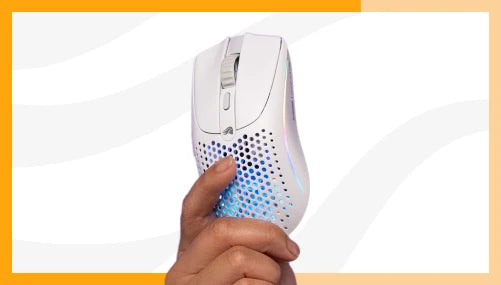
The Model O Eternal - Wired weighs 55g, it sits well below that threshold without compromising build integrity. The 128mm length and 67mm width fit medium-hand palm and claw grip - the two grip styles most common in FPS play.
The Model O3 Wireless weighs 59g without the 200mAh battery pack, 66g with it installed. The tapered body - 65.73mm at the base, 60.73mm at the top - narrows toward the front contact surface where fingertip and claw grip players rest their fingers during aim corrections.
PC Gamer reviewed the Model O Eternal and highlighted its weight as a core strength at its price point.
"The 55 g weight makes this Eternal mode significantly lighter than the OG's 67 g mass, and firmly leans into its ultralight origins. It's one of the lightest mice I've used in recent times, and it feels quite responsive." - Reece Bithrey, PC Gamer
Polling Rate
Polling rate determines how often your mouse tells the computer where it is. At 1,000 Hz, that is one report per millisecond. At 8,000 Hz, one report every 0.125ms.
For FPS play, 1,000 Hz is the baseline. It is fast enough that movement-to-screen lag is not the hardware limit - aim consistency is. The step to 8,000 Hz produces a measurable improvement in cursor smoothness at high movement speeds, which some competitive players notice in fast flick scenarios.
The Model O Eternal - Wired polls at 1,000 Hz. The Model O3 Wireless polls at up to 8,000 Hz wirelessly.
Sensor
Sensor performance for FPS is about accuracy at the DPI you actually use - not the ceiling on the box. The sensor needs to track without hardware acceleration, angle snapping, or prediction at the sensitivity settings competitive players run.
The Model O Eternal - Wired uses an optical sensor with a 50 to 12,000 DPI range. The Model O3 Wireless uses the BAMF 3.0 30K sensor with a 50 to 30,000 DPI range. Both perform accurately within competitive FPS DPI ranges. The ceiling difference between 12,000 DPI and 30,000 DPI is irrelevant at 800 DPI. What matters is that neither sensor adds processing at your working settings.
Wired vs. Wireless for Competitive FPS
The latency argument against wireless is settled at this polling rate tier. The Model O3 Wireless runs at up to 8,000 Hz wirelessly - faster in report frequency than the Model O Eternal - Wired at 1,000 Hz. The performance question is not the issue. GamesRadar+ reviewed the Model O3 Wireless in a hands-on piece.
What remains is cable drag and battery management.
Cable drag. In claw and fingertip grip at low sensitivity, micro-corrections are constant. A stiff cable creates resistance in directional changes - small, cumulative, present on every movement. Wireless removes that variable.
Battery management. The Model O3 Wireless runs up to 71 hours per 200mAh pack at 2.4 GHz. The InfinitePlay System means you swap the pack rather than charge the mouse - the Guardian Battery System keeps it connected throughout the swap. Running flat mid-match is the one wireless failure mode in FPS. InfinitePlay removes it.
The Model O Eternal - Wired at $39.99 is the argument for wired: no battery variables, no wireless receiver, no cable drag at lower price. The Model O3 Wireless at $159.99 removes the cable at the cost of battery management and budget.
Our FPS Picks
Model O Eternal - Wired: The Wired Baseline
55g. 1,000 Hz. Optical sensor. $39.99.
Those four numbers cover the FPS hardware floor. The sensor tracks accurately at competitive DPI settings. The polling rate covers the standard competitive threshold. The weight sits well under 70g. The 80 million rated mechanical switches mean click longevity is not a near-term concern.
For FPS players who want the cable variable gone from the equation but cannot justify the wireless premium - or for anyone building their first real FPS setup - this is the starting point.
Model O3 Wireless: The No-Cable Pick
59g without battery. 8,000 Hz wireless. BAMF 3.0 30K. $159.99.
For FPS players who have made the jump to wireless and do not want to go back, the Model O3 Wireless runs 8,000 Hz at 2.4 GHz and weighs 59g unloaded - under the 70g competitive threshold even with the battery installed at 66g. The 130 million rated optical switches handle high click-volume sessions. [Spec - verified per product sheet.] The InfinitePlay battery swap covers the one scenario where wireless fails mid-match.
PCGamesN reviewed the Model O3 Wireless in a hands-on piece. [Citation: https://www.pcgamesn.com/glorious/model-o3-wireless-review]
For game-specific picks including Valorant, see our best mouse for Valorant guide.
Frequently Asked Questions
Does mouse weight actually affect FPS aim or is it placebo?
Weight affects the physical effort required for every aim movement, not aim accuracy in isolation. At low sensitivity settings where arm sweeps replace wrist flicks, a heavier mouse requires more deceleration and re-acceleration on each correction. Over a session this accumulates. At high sensitivity with small wrist movements, the difference is smaller. The Model O Eternal - Wired at 55g ±4g and the Model O3 Wireless at 66g with battery both sit under the 70g threshold most competitive FPS players target.
Should I use wired or wireless for competitive FPS?
At 2.4 GHz with high polling rates, wireless mice operate without meaningful latency disadvantage over wired at standard polling rates. The Model O3 Wireless polls at up to 8,000 Hz wirelessly. The decision comes down to cable drag and battery management. Wired removes battery as a variable. Wireless removes the cable. The Model O Eternal - Wired at $39.99 covers wired; the Model O3 Wireless at $159.99 covers wireless.
What polling rate do I need for FPS games?
1,000 Hz is the standard competitive baseline - one position report per millisecond. The Model O Eternal - Wired polls at 1,000 Hz. The Model O3 Wireless polls at up to 8,000 Hz wirelessly. For most FPS players at ranked and below, 1,000 Hz is not the hardware limit. The step to 8,000 Hz produces measurable improvements in cursor smoothness at high movement speeds; whether that translates to in-game results depends on the individual.
What DPI should I use for FPS games?
Most competitive FPS players run 400 to 1,600 DPI with low in-game sensitivity. At those settings, neither the optical sensor in the Model O Eternal - Wired nor the BAMF 3.0 30K in the Model O3 Wireless introduces tracking issues. The sensor ceiling - 12,000 DPI or 30,000 DPI - is irrelevant at the DPI competitive players actually use.
Is the Model O Eternal - Wired or Model O3 Wireless better for FPS?
Both cover the FPS hardware baseline. The Model O Eternal - Wired at 55g and $39.99 is the wired option: no battery to manage, no wireless receiver, lower cost. The Model O3 Wireless at 59g without battery and $159.99 removes the cable and raises the polling rate ceiling to 8,000 Hz wirelessly, at the cost of battery management and budget. The right choice depends on whether cable drag is a constraint and whether the wireless premium fits the setup.
See the full Glorious mouse lineup at gloriousgaming.com/collections/mice.