

Best Keycaps 2026: Ranked by Feel, Look, and Longevity
Guides & Resources
Jun 22 2026
The two keycap sets worth knowing about from the Glorious lineup in 2026 are built from different materials for different priorities. The Glorious Aura V3 Keycaps are PBT — harder, more matte, more resistant to the shine and surface degradation that stock ABS caps develop over time. The Glorious Polychroma V2 RGB Keycaps are Polycarbonate — the entire cap is translucent, with black printed legends on top, so your board's RGB shines through the whole surface rather than being blocked by an opaque cap. Neither is a universal "best" — but both are material upgrades over what ships in most pre-builts.
Why Keycaps Are the Last Thing Most Builders Upgrade (and Shouldn't Be)
Your keycaps are the part of your setup you interact with most. Every keystroke runs through them. They're the first thing you see when you sit down. And they're almost always the last thing people swap out.
Part of that is inertia — stock keycaps work, and "work" feels like good enough. But "work" and "worth keeping" are different evaluations. The keycaps on most pre-built mechanical keyboards are ABS plastic, chosen because they're cheap to manufacture and easy to injection-mold. They do the job. They also develop a glossy sheen within months of regular use, because ABS is a softer plastic that reacts to skin oils and repeated friction.
PBT is harder and more heat-resistant than ABS, and resists that surface degradation better over time. Polycarbonate brings a different advantage: it's the material that lets RGB lighting actually show through a keycap rather than being buried behind an opaque surface.
The other half is aesthetics. For a builder who's spent time on switches, stabilizers, and a custom case, leaving stock ABS caps on at the end is leaving the most visible part of the build unfinished. Keycaps are not an accessory — they're the surface you see.
Keycap Materials Explained: PBT, ABS, and Polycarbonate
Most keycap discussions start and end with PBT vs. ABS. That covers the majority of the market, but if you're shopping for an RGB-forward build, Polycarbonate enters the picture. Here's what each material actually means for everyday use:
ABS (acrylonitrile butadiene styrene). The default on most pre-built keyboards. Affordable, easy to mold, available in almost any colorway. The trade-off is surface durability: ABS reacts to skin oils and friction, developing a glossy sheen in high-contact zones — typically the WASD cluster and the most-used alpha keys — over time. How fast this happens depends on usage intensity and skin chemistry, but it's a consistent pattern.
PBT (polybutylene terephthalate). Harder and more heat-resistant than ABS. The surface texture is slightly coarser and more matte, which most builders describe as more solid-feeling under the fingers. PBT resists the shine and surface wear ABS develops because the material is denser and less permeable to oils. It's the material the Glorious Aura V3 Keycaps use — chosen for builds where longevity and surface feel matter more than RGB light transmission.
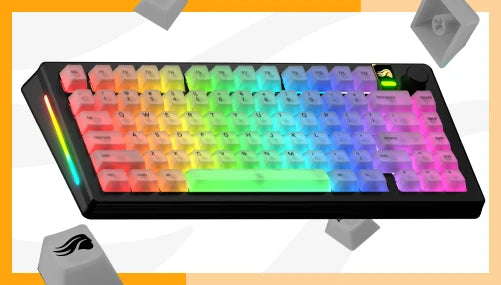
Polycarbonate (PC). Naturally translucent, which is why it's used in RGB-optimized keycap sets. The Glorious Polychroma V2 RGB Keycaps are made from translucent Polycarbonate across the entire cap body, with black printed legends on top. The result is that your board's RGB shines through the whole surface of every key — not just at the switch stem or through a cutout, but the entire cap glows. For builds where per-key RGB is active and part of the aesthetic, PC is the right material. For builds where RGB is off or not a factor, PBT's durability and surface texture are the stronger reasons to upgrade.
Legend printing. Material choice determines which printing methods work, and the printing method determines how long the legends last. The two durable methods are:
Dye sublimation (dyesub) — presses dye into the plastic at high temperature. The legend is part of the plastic surface, not a layer on top of it. Dyesub is standard on PBT sets because PBT is compatible with the heat required. Because the dye is embedded, the legend doesn't wear off from contact.
Doubleshot molding — uses two separate plastic layers (a legend layer and a base layer) fused together so the legend is structurally part of the cap. Works on both ABS and PBT. Same outcome: the legend is not a surface coating that can wear away.
Both methods are significant durability improvements over pad-printing, which applies ink to the cap surface and is what most stock keycaps use.
Two Sets, Two Materials: Glorious Aura V3 Keycaps and Glorious Polychroma V2 RGB Keycaps
Glorious produces two keycap sets aimed at aesthetics-first builders, each using a different material for a different use case. Both are designed to upgrade from stock keycaps on hot-swap boards, including the GMMK 3 family and other MX-compatible keyboards.
Glorious Aura V3 Keycaps — PBT
The GPBT Aura V3 Keycaps are a pudding-style set in opaque black or white PBT. The top cap is solid — legends are doubleshot, molded in rather than printed on, and won't wear through. The translucent lower body produces RGB side-glow when lighting is active, but the set is designed to work as a complete aesthetic without it. Black or white PBT reads clean regardless of whether your RGB is on.
For builders who want a keycap set that holds up visually and physically over time, the Aura V3 is the call. The PBT construction resists shine. The colorway is deliberate rather than decorative. If you're running a board with RGB active and want the lighting to be the centerpiece of the build rather than a backdrop, that's where the Polychroma V2 RGB takes over.
Glorious Polychroma V2 RGB Keycaps — Polycarbonate
The Polychroma V2 RGB is built for boards with per-key RGB. Each keycap is fully translucent Polycarbonate — the entire cap body lets light through, with black printed legends on top. The effect is that every key on your board glows, with the legends reading as dark text against an illuminated cap. It's a fundamentally different look from colorway-based keycaps: the RGB is the aesthetic, not an accent.
For builders running a GMMK 3 or GMMK 3 PRO with RGB active, the Polychroma V2 RGB is the upgrade that turns the lighting into the centrepiece of the build. If your board's RGB is off, or if you've never used it, the Aura V3's PBT construction and colorway-first design are the better direction.
This is a use-case decision, not a quality ranking. The Polychroma V2 RGB is optimized for one thing — RGB-visible builds — and it does that by using the right material for light transmission.
Layout Compatibility: What to Check Before You Buy
Keycap compatibility is a legitimate purchase variable and one that trips up first-time upgraders. A set that doesn't support your layout is a return, not an upgrade.
The key variables:
Layout and key count. Full-size ANSI is 104 keys. TKL (tenkeyless) is 87 keys. 75% is typically 84 keys. 65% runs around 68 keys. 60% is 61 keys. A set that covers full-size ANSI will usually support TKL and 75%, but compact layout support (65%, 60%) varies by set and needs explicit confirmation before purchase.
Stem compatibility. Virtually all Cherry-profile sets use MX-compatible stems (cross-shaped) — the standard for the GMMK 3 lineup and the full Glorious switch ecosystem (Glorious Fox Switches, Glorious Lynx Switches, Glorious Panda Switches, and the hall effect variants). If you're on Alps, Topre, or low-profile switches, MX stems won't fit regardless of keycap material.
Row profile. Glorious keycap sets use different row profiles depending on the set — the GPBT Aura V3 uses OEM profile, while the Polychroma V2 RGB uses Cherry profile. Both are common in the enthusiast market, but they are not interchangeable: each has a specific height and curvature per row, and mixing profiles on a single board affects typing feel. Check which profile a set uses before buying if you're particular about hand position or if you're mixing in third-party keycaps.
Modifier coverage. 60% and some 65% boards use non-standard modifier sizes — particularly right shift, the bottom row, and occasionally the enter key. Standard keycap sets don't always include these. Check the in-box modifier list against your board's layout, not just the main alphanumeric block.
For GMMK 3 and GMMK 3 PRO builders, Glorious keycaps are designed to be compatible with the GMMK lineup.
If you're pairing a keycap upgrade with a first board build or choosing a keyboard that accepts aftermarket keycaps, the best budget mechanical keyboard guide covers which boards support standard hot-swap and what layout to start on. For the full Glorious keyboard lineup and layout options, the keyboards collection has current availability.
How to Read a Keycap Listing Before You Buy
Five things to confirm before checkout on any keycap set:
Material (PBT, ABS, or Polycarbonate). PBT is the durability-first choice — harder surface, resists shine. ABS is the stock default on most pre-builts — softer, develops gloss over time. Polycarbonate is the RGB-first choice — transparent enough to let LED light through, used in sets like the Polychroma V2 RGB where light transmission is the point.
Legend method (dyesub, doubleshot, or pad-print). Pad-print is the weakest — ink on the surface that wears with use. Dyesub and doubleshot are both long-term options; the difference is manufacturing method and material compatibility.
Profile (Cherry, OEM, SA, DSA, MT3, KAT, etc.). Cherry is the most common. Each profile has a distinct height and curvature per row. A Cherry-profile board with OEM caps feels different enough that it's worth checking before you commit.
Layout support. Verify specifically for your board's layout — alphanumeric block first, then modifiers, then any non-standard keys (ISO enter, non-standard right shift, split spacebar variants).
In-box extras. Some sets include additional modifier keys for compact or non-standard layouts. Some don't. If your board needs non-standard modifiers, confirm they're included or available as add-ons before ordering.
These aren't preference decisions — they're compatibility checkboxes. Clear them before buying any set.
FAQ
What are the best keycaps in 2026 for feel, look, and durability? For durability and surface feel, PBT keycaps with dye-sublimated or doubleshot legends are the standard. The Glorious Aura Keycaps V3 are PBT, built for colorway-first builds where long-term surface quality matters. For RGB-active boards, the Glorious Polychroma V2 RGB Keycaps are fully translucent Polycarbonate with black printed legends — the entire cap glows with the board's RGB, not just the legend area. Choose the material that matches your build priority.
Is PBT worth upgrading from stock ABS keycaps? PBT resists surface shine and wear better than ABS over time. If your current keycaps are developing a glossy sheen where you type most, that's ABS surface degradation, and PBT addresses it. For builders who care about how the setup looks and feels after months of daily use, the material difference is real.
What is the difference between dyesub and doubleshot keycap legends? Dye sublimation presses dye into the plastic at high temperature, making the legend part of the cap material. Doubleshot molding uses two separate plastic layers so the legend is a physically distinct layer fused into the base. Both outlast pad-printed legends, which sit on the surface and wear through with use. Dyesub is standard on PBT; doubleshot works on both ABS and PBT.
Are Glorious keycaps compatible with my keyboard? Glorious keycaps use Cherry-profile MX-compatible stems, which fit most mechanical keyboards including the GMMK 3 and GMMK 3 PRO. Compatibility with compact layouts (65%, 60%) depends on the specific set's modifier coverage. Check the keycap set's compatibility list against your board's layout before purchasing, especially for non-standard modifier sizes.
Do keycap profiles matter if the stem fits? Yes. Profile determines the height and curvature of each row, which affects typing feel and angle. Cherry profile is the most common and fits the GMMK 3 family. OEM, SA, DSA, and MT3 are different profiles — they'll physically attach if the stem fits, but the typing angle and height will differ from what your board was designed for. Match the profile to your board's row layout.
The Short Version
Your switches get chosen carefully. Your case gets picked for a reason. The keycaps are what you look at and type on for every hour at the board.
Two directions from Glorious in 2026: the Glorious Aura V3 Keycaps in PBT for a durability-forward set that holds up to daily use without developing the gloss that makes stock caps look worn. The Glorious Polychroma V2 RGB Keycaps in fully translucent Polycarbonate for boards where RGB is the point — the whole cap glows, with black legends on top, so every key is part of the lighting.
Check your layout. Check your profile. Then upgrade the part you've been putting off.