


Model O3 Wired vs Wireless: The InfinitePlay Difference
Guides & Resources
Jul 23 2026
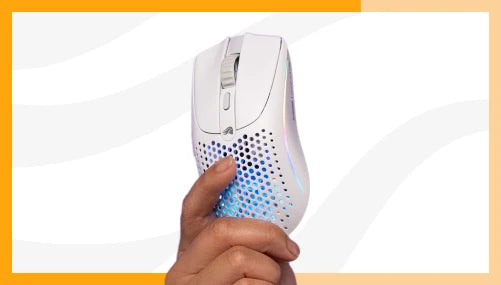
Model O3 Wired and Model O3 Wireless share the same BAMF 3.0 30K sensor, 130-million-click optical switches, and shape. Wired weighs 54g and costs $69.99, capped at 1,000 Hz polling. Wireless weighs 66g with its battery installed, costs $159.99, and reaches 8,000 Hz over 2.4 GHz through the InfinitePlay swappable battery system. Pick Wired for price, Wireless for cable freedom.
Same Mouse, Two Ways to Power It
If you've already narrowed your search to the Model O3 line, the sensor decision is done. Both versions run the BAMF 3.0 30K sensor, the same 130-million-click optical switches, 100% PTFE mouse feet, 750 IPS max tracking speed, and 50G max acceleration. Six remappable buttons, symmetrical right-handed shape, two-year warranty. None of that changes based on which one you buy.
What changes is everything downstream of the battery. Model O3 Wireless runs 0.83mm longer than Model O3 Wired, 127.05mm against 126.22mm, to make room for its swappable battery compartment. Everything else about the shell is close enough that PCGamesN's Edward Chester described the O3 Wireless as sticking to "classic Glorious Model O" ergonomics, calling the shape "excellent" in a symmetrical, palm-or-claw-friendly form. Buying wireless isn't buying a different mouse shape. It's buying the same platform with a battery bay added.
The Weight and Price Gap
Model O3 Wired weighs 54g ±3g. Model O3 Wireless weighs 66g with its 200mAh battery seated, or 59g without it, per the product spec sheet. PCGamesN's own scale read the battery-out weight at 61g, and PC Gamer's Jacob Fox weighed the fully loaded mouse at 67g against Glorious's listed 66g.
The price gap is bigger than the weight gap. Model O3 Wired retails at $69.99. Model O3 Wireless retails at $159.99, a $90 premium for the identical sensor, switches, and shell. That $90 buys the InfinitePlay charging dock, two swappable 200mAh battery packs, and a 2.4 GHz USB-A dongle. The mouse underneath is identical either way. If the sensor and switches are what sold you on Model O3 in the first place, that part of the purchase is already settled.
What InfinitePlay Actually Adds
InfinitePlay is the reason Model O3 Wireless costs more, and it's an answer to a specific problem: a wireless mouse that dies mid-match. The mouse runs on an external 200mAh battery that slides into the rear of the shell, backed by an internal Guardian Battery that keeps the mouse powered and connected the instant that external battery is pulled. InfinitePlay never turns off and never disconnects during a swap.
PC Gamer's Jacob Fox described the mechanism directly: "your mouse doesn't disconnect while swapping out your batteries, which means you're less likely to run into any strange issues." PCGamesN's Edward Chester called the swap itself simple enough to do almost without looking: pull the spent pack, click in the charged one, and the mouse never leaves the desk. The batteries themselves push and click into place from the rear of the mouse and release with a second push, according to Chester's teardown of the mechanism.
Battery Life, By the Numbers
At 1,000 Hz polling with RGB off, a single external battery plus the Guardian Battery covers up to 71 hours over 2.4 GHz, per the Glorious product spec sheet. PCGamesN corroborated that exact figure independently, then measured a second battery, swapped in after the first drains, adding roughly 57 more hours before it needs a recharge, a full two-battery rotation lasting somewhere in the 120-plus-hour range at 1,000 Hz.
Push polling to the 8,000 Hz maximum and those numbers fall fast. PCGamesN measured roughly 14.8 hours from the first battery and Guardian Battery combined, and about 27 hours across a full two-battery cycle at 8,000 Hz. The Guardian Battery itself carries about 10 hours of backup power on its own, corroborated independently by both PCGamesN and GamesRadar+.
In practice, that maps to a battery swap every three to four days at 1,000 Hz for all-day use, or daily at 8,000 Hz, per PCGamesN's usage estimate. GamesRadar+'s Tabitha Baker reported swapping batteries "roughly every other day" across three weeks of her own regular use. Model O3 Wired asks none of this of you. There's no swap habit to build because there's no battery to manage.
The Polling Rate Twist
Model O3 Wireless reaches 8,000 Hz over its 2.4 GHz connection, the highest polling ceiling in the Model O3 lineup. Plug that same mouse in over its own USB-C cable and the ceiling drops to 1,000 Hz, a limit PCGamesN confirmed directly in its review of the Glorious Core software settings, which list "wired and wireless polling rates (up to 8kHz for wireless, up to 1kHz for wired)." Model O3 Wired, the dedicated wired mouse, ships with that same 1,000 Hz ceiling as its maximum.
GamesRadar+'s Tabitha Baker flagged the same wired-mode cap independently, noting the mouse behaves "like many esports mice" where "the max on the cable is 1,000Hz, which I still find odd to this day." For a deeper look at why this reversal shows up across the wider wireless mouse category, not just this SKU, see the wired vs wireless gaming mouse guide.
Answering the Objections
"Is the wireless worth the price jump if I never untether my desk?" If your setup stays put and the cable never catches on anything, the $90 gap buys you a higher polling ceiling and one less cable, not a performance upgrade on the sensor or switches, since both mice share those. Model O3 Wired gets you the identical core hardware for less.
"What's the catch with InfinitePlay? Are batteries expensive or hard to find?" The dock and two 200mAh packs ship in the box, so day one requires nothing extra. If further down the line you lose one battery and need a replacement, Glorious sells a 500mAh InfinitePlay battery separately for $19.99
"Does the wireless feel different even though it's the same shape?" PCGamesN's Edward Chester noticed the balance shift slightly once the battery comes out, describing the mouse as feeling a touch lighter and better balanced without it seated. That 7g swing between battery-in and battery-out is a slight difference in how the wireless version might feel for you, depending on your use case. But both wired and wireless feel identical shape-wise, with only slight differences in weight.
Which One Should You Buy?
Pick Model O3 Wired if: you want the BAMF 3.0 sensor and 130-million-click switches at the lowest entry price, $69.99, and you'd rather never think about a battery.
Pick Model O3 Wireless if: cable freedom and the 8,000 Hz polling ceiling are worth $90 to you, and you're fine with a battery swap every few days depending on how you run polling rate.
Both mice are the same core hardware wearing a different power source. The decision comes down to whether InfinitePlay's swap ritual is worth more to you than $90 and a permanently stable weight.
FAQ
What's the difference between Model O3 Wired and Model O3 Wireless? Both run the same BAMF 3.0 30K sensor and 130-million-click optical switches. Model O3 Wired weighs 54g, costs $69.99, and caps at 1,000 Hz polling. Model O3 Wireless weighs 66g with its battery, costs $159.99, and reaches 8,000 Hz using the InfinitePlay swappable battery system.
Is Model O3 Wireless heavier than Model O3 Wired? Yes. Model O3 Wireless weighs 66g with its 200mAh battery installed against 54g for Model O3 Wired, per the Glorious product spec sheet. Without its battery, Model O3 Wireless drops to 59g by spec, though PCGamesN measured it closer to 61g on their own scale.
How long does the Model O3 Wireless battery last? Up to 71 hours per external battery at 2.4 GHz with RGB off and 1,000 Hz polling, per the Glorious spec sheet. PCGamesN measured roughly 57 additional hours from a second swapped-in battery at the same settings, and about 14.8 hours per battery cycle at the maximum 8,000 Hz polling rate.
Does Model O3 Wireless have a higher polling rate than Model O3 Wired? Yes, but only over its wireless connection. Model O3 Wireless reaches 8,000 Hz over 2.4 GHz, while its own wired mode and the dedicated Model O3 Wired both cap at 1,000 Hz, per PCGamesN's and GamesRadar+'s testing.
Is InfinitePlay worth the extra cost? That depends on how much a cable-free desk and the higher polling ceiling matter to you. InfinitePlay adds $95 to the price and a recurring battery swap, roughly every few days depending on polling rate, in exchange for never plugging in the mouse to charge it.